Mark Wood: Mark Wood:
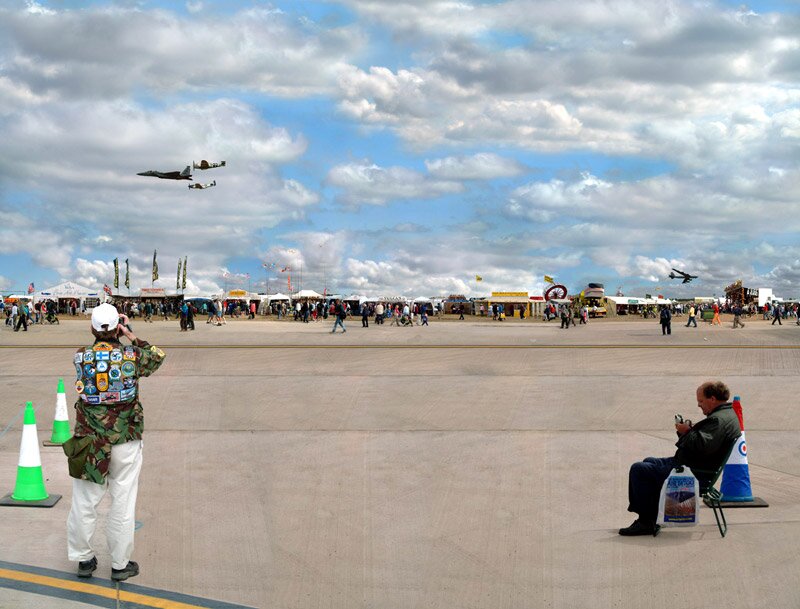
We have an exclusive copy of Mark's picture in the Stoke (Four Counties) Open, Planespotters, which won the 2002 Sentinel prize....
Click for full image (120kb)
CREATIVE STOKE interviews Mark Wood:
CS: Mark you're a digital artist based in North Staffordshire, a University lecturer, and a commercial creative designer, all rolled into one. Furthermore you've attracted grant funding in the shape of a Creative Ambitions Award from West Midlands Arts, which supported the production of your digital-imaging/web project Constructed Spaces.
MARK: It can seem a conceit to claim so much but many artists do work across the "boundaries" imposed by the institutionalised. The discipline of graphic design practice - mixed with the exploration of process gained from printmaking - realised through the medium of computer technology - is pretty much "my thing".
Constructed Spaces embodies all the key aspects of my practice. In retrospect, the work I'm doing for Constructed Spaces has been evolving as a "mode of work" ever since my foundation course at North Staffordshire Polytechnic in 1987. Much later, a decade later actually, I realised I'd resolved something when I made the piece A Bit Like Penny Lane, on my M.A. degree. The work had qualities that intrigued me; and not just me, others too. The landscapes I create are built up from hundreds of photographs. The photographs are reportage....
CS: Reportage?
MARK: ... yes, although "assembled", an important criterion I use to assess when a work is complete is the point when the many images appear to be one. Meaning that, in the instance of first encounter with my work, the viewer reads the image in front of them, at least for a few seconds as being "one photograph". After that instant the incongruities I leave in the work reveal the piece"s true nature; the same person may be captured walking across the image several times! Or, the trees of winter and summer occupy the same "decisive moment". However, I do remove the evidence of "joins" in the work. In the photomontage - exemplified by John Heartfield - the joins of the multiple images cannot be wholly hidden; nor should they be. Computer technology allows the work to be seamless and I enjoy exploring the unique qualities of a process, so therefore � no joins!
CS: Nevertheless, you work consciously uses discontinuities; and so that perhaps allows it to come closer to the reality in people's heads than a "real" photo?
MARK: Yes I do bring together images that were not shot in the same place, month or year.
CS: ...and as such, your work perhaps understands the sort of "critical pride" people have for their own region. Is there a desire to celebrate 'the local', a 'sense of home' in your choice of the Stoke-on-Trent area as the seam of raw image-making material for your digitally-manipulated artworks?
MARK: I'm photographing Stoke because I can access it readily; and that does lead to questioning issues of familiarity and the 'sense' of being local. A logistical reason for choosing Stoke is that on days of appropriate weather I can get to locations quickly. Stitching together hundreds of shots is time consuming enough, without the added complication of digitally enhancing an image because the light was poor!
So my work does celebrate a sense of "home" town and region, the familiar that I make unfamiliar. I believe that I'm drawing from the rich diversity of my local urban environment, although my work does speak to people who have never visited Stoke-on-Trent. Some of my work involves the anonymous vistas of out-of-town retail parks, punctuated with the ubiquitous MacDonald's and KFC's. Building materials and architecture style use to give a place a singular identity; the red brick mills of Manchester; the stone-built mills of Halifax; the concrete of - well - the West Midlands. The "concrete" remark maybe harsh but I'm not allying myself with the Spectator writer who infamously stated that Walsall is the ugliest town in Britain - "like Ceausescu's Romania with fast-food outlets".
Anyway, what I'm trying to say is that amongst the 1960s shopping arcades of Stoke are some wonderful, intriguing and honest spaces. Now, I don't mean the quaintly curious alleyways punctuated by trendy coffee shops, laced with twee pretensions.
CS: One of your best-known images is of derelict Grand cinema in Leek ?
MARK: The digital image of The Grand relates to recent changes. The Grand was my local cinema. It was the last cinema in my hometown; it's where I saw most of the films of my childhood. It"s been closed since I was fifteen and was demolished this year.
People make a place; and over time we all change; therefore the identity of a place changes. I've always retained a sense of home. It's a place where family and friends reside; though the pressures of work have forced many close to me to relocate to far flung places, so "home" isn't quite as cosy as it once seemed.
CS: Do you see your work as documenting the erosions and letdowns that took place within English identity and citizenship, in that time when the promise of the 1960s faded and 'we' were left stranded in these rain-sodden peeling post-Imperial/industrial spaces?
MARK: The themes in my work don't just comment on the 1960s vision of town planning. Though your observation is a valid one. I"ve found places that can be seen as celebrating the individual's enterprise in the face of corporate chain-store marketing.
Additionally, I'm looking to populate my new works. One piece The Garden of Earthly Delights (after Hieronymus Bosch) will contain the pensioners that shop in Newcastle-under-Lyme in the daytime mixed in with the half-naked, hedonistic club-goers of the night. The night scenes will have to wait until high summer!
CS: In Summer 2002 you had a new show in Leek, Fresh?
MARK: Yes, I took back my Constructed Spaces works from MADE, who were touring it as a show. Fresh was held at The Moorland Arts & Antique Centre which is a great space, and a local resource that deserves support. So I put most of the touring show in there along with some early work related to local rural landscapes. With so much of my work relating to the values of "home-town" it made sense to put the show into my hometown. The resulting show was quite challenging for the lovers of pastoral landscapes but the resulting dialogue has been very useful.
CS: What next?
MARK: The New Year is going to be a fabulous change. I'm focusing my energies on my personal work and design practice; I've resigned my associate post at Loughborough University.
CS: An example of courage to us all.
MARK: The success of Planespotters (see above) is opening up new possibilities for work; I have been meeting lots of people with a view to collaboration. I've been invited to submit proposals for commissioned work. My new work builds on the architectural premise of Constructed Spaces but comments more on social activities; The Garden of Earthly Delights and Planespotters are pointers to the direction of the new work. Greater contextualisation of my practice through reading, and my new camera, will both aid this. The reading helps me take my work further, building on the practice of other creatives. My prefessional Fuji digital camera allows me to take crisp telephoto shots, which means I can photograph people from a distance; people act differently once they are aware of my camera.
2003 will see lots of new work being created. I'll be negotiating further exhibitions, commissions and residencies. I'll be updating my web-sites with all the developments as often as possible.
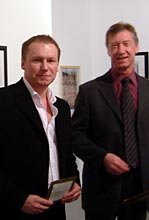
December 2002: Mark is handed the 2002 Sentinel Prize, awarded by Stoke City Council's Director of Regeneration (right), on behalf of the Sentinel newspaper.
Update: February 2003 - Mark has been offered a solo exhibition at Keele University's Art Gallery.
|