Frink School of Figurative Sculpture Frink School of Figurative Sculpture

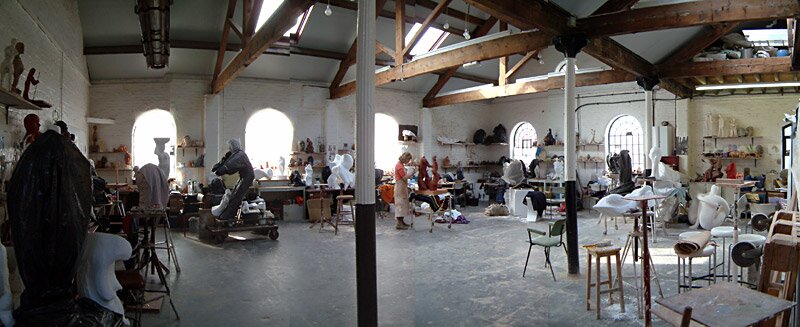
The north side of the main studio. (Larger version, 100kb).
CREATIVE STOKE talks to Rosemary Barnett, head of The Frink School of Figurative Sculpture, near Stoke-on-Trent.
CREATIVE STOKE: I get a sense that you're a very unique institution, which is why we wanted to interview you and feature you on Creative Stoke; firstly - what are the reasons behind the School's approach, and secondly - is there anyone else doing what you're doing, strongly adhering to traditional teaching methods, focussing on the making of figurative work, and working with small cohorts of mature students to continue the artisan tradition?
FRINK: Every person or indeed every sculptor has their own approach to things. My approach - and therefore the Frink School's approach - is unique. The School teaches traditional craft skills, in the belief that a real tradition is not the relic of a past that is irretrievably gone; it is a living force that animates and informs the present.

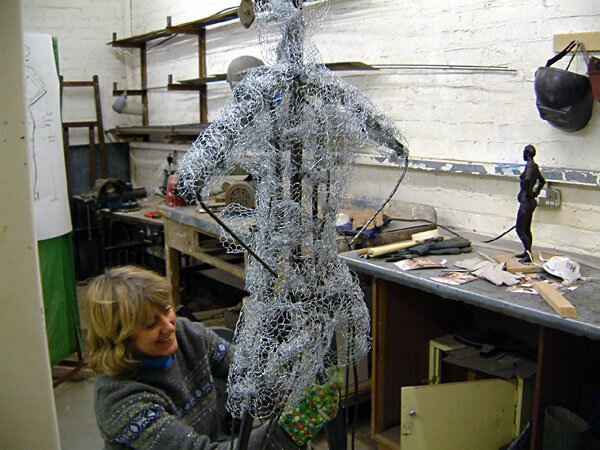
Student at work in the Welding Room, making a wire frame from her small model (seen on the bench). (Larger version, 86kb).
CS: Who are your inspirations?
FRINK: There are very few living sculptors who inspire us. We look to the sculptors of the 20th Century for guidance.
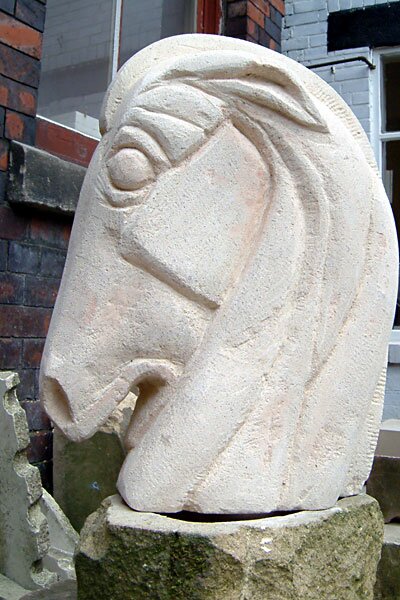
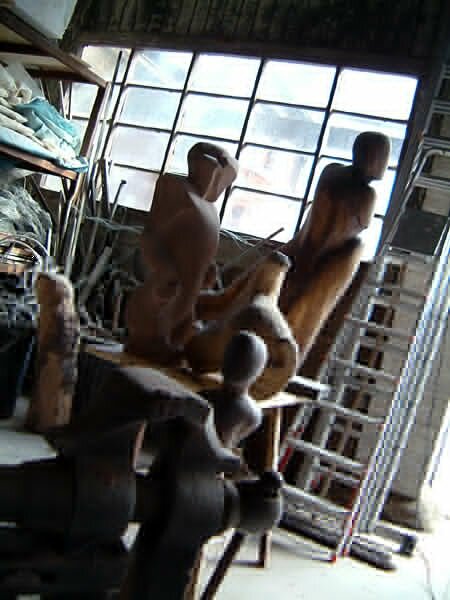
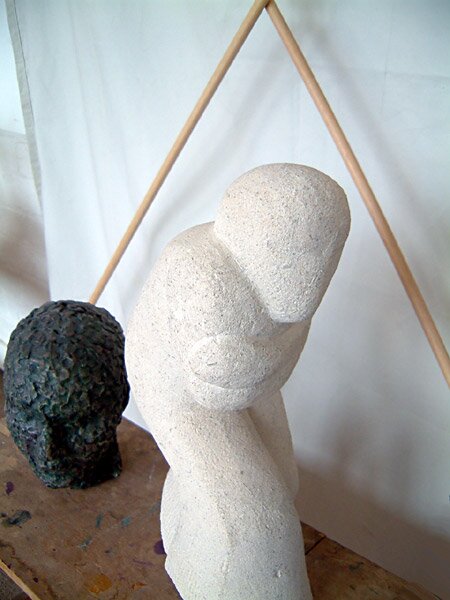
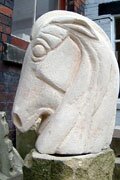 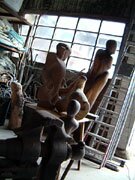 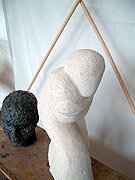 Horse's head (77kb) | Yard figures (86kb) | Crouching figure (65kb) Horse's head (77kb) | Yard figures (86kb) | Crouching figure (65kb)
CS: Is Stoke a good place for creating sculpture? Are you able to tap into local families who have traditions of being high-skilled workers in the ceramics industry as modellers, painters, etc?
FRINK: Stoke-on-Trent is the perfect location for a sculptor. There is an inate understanding of sculpture here. Yet the people have been oppressed for three hundred years and many do not realise their own abilities. Most of our students come from other parts of the country or abroad.

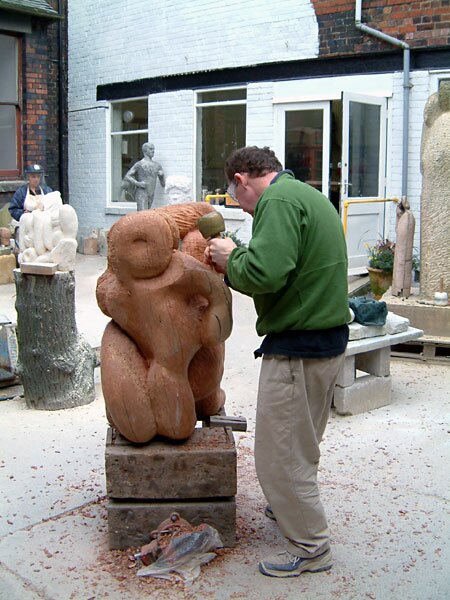
Student in the yard, working with wood. (Larger version, 84kb).
CS: Someone said recently "abstract art is now as safe, and probably as tired, as any watercolor scene of boats". What's your reaction to that, in terms of the more abstracted representations of the human figure?
FRINK: All sculpture is abstract! :-)

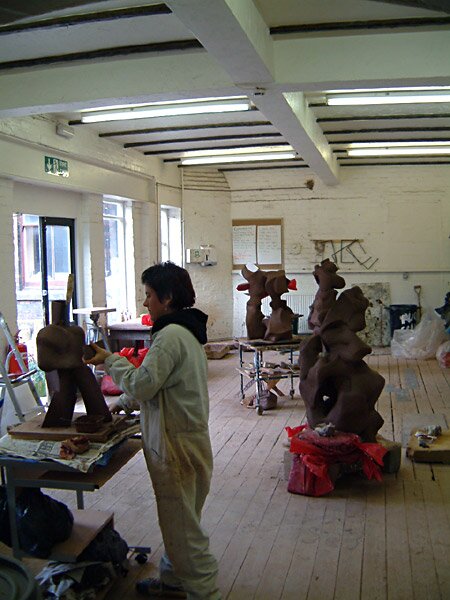
Student at work in the Clay Room. (Larger version, 88kb).
CS: What part does 'working from life' play in the creative process?
FRINK: Working from life is just a way of training the eye & hand to relate shapes. The human body possesses the most subtle shapes of anything on Earth.

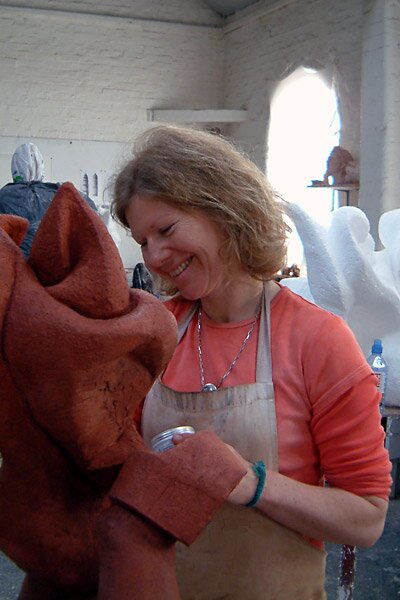
Student in the Main Studio, applying surface colouring (Larger version, 62kb).
CS: On completion, where do students go to? Geographically, but also in terms of their sense-of-community with other sculptors?
FRINK: Some remain in Stoke-on-Trent or nearby areas, while others return to where they came from. The Frink is like an ever-growing family - the students do remain in contact and are supportive of each other.

Letter-carving in stone, in the yard (Larger version, 62kb).
CS: Is this - after graduation - a skill which a student can afford to persue if they don't make a dedicated career of it?
FRINK: People come to the Frink because they want to make sculpture a dedicated career.

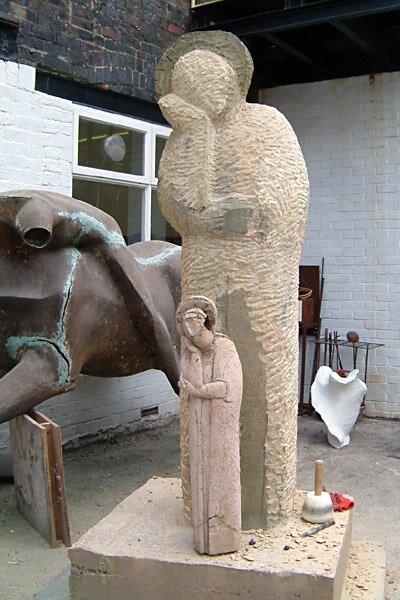
Partly-carved saint, with small model next to it. (Larger version, 91kb).
CS: Obviously there's the day-to-day thinking involved in running the School. But is there a bigger time-scale that is assumed or at the back of your mind? What do you think posterity will say - or the girl starting to sculpt in two hundred years time will think, when she looks back over her shoulder at what the Frink School did?
FRINK: Well, nothing remains forever. The Frink may be remembered for doing what it could to keep the tradition of sculpture alive - as a language in its own right - at a time when it was unfashionable.
CS: Let's hope so! Rosemary Barnett, thank you.

The frontage of the Frink School, in Tunstall, Stoke-on-Trent. (Mar 05 update: Moved to Leek, near Stoke)
The Frink holds regular Open Days - visit their web-site or call for more information. The annual exhibition is held in London, usually in May. The School was located in Tunstall, and from 1st March 2005 will relocate to Leek, near Stoke-on-Trent.
Rosemary Barnett FRBS was principal of the Sir Henry Doulton School in Fenton, Stoke-on-Trent. Rosemary is a sculptor, Curator for the Jerwood Sculpture Park in Warwickshire, and a judge for the prestigious Jerwood Sculpture Prize. Dame Elisabeth Frink RA (1930 - 1993) was very involved with this school, and it is named after her. Lin Jammet, her son, is patron of the School. After her death Rosemary Barnett FRBS founded the Frink School of Sculpture in Longton with the help of Harry Everington. From 1996 - 2000 The Frink was based in Longton, then in in Tunstall from 2000 - 2005. From 2005 it will be based in Leek, near Stoke-on-Trent.
|