|
 Setting up & running an art gallery: Setting up & running an art gallery:
THE CREATIVE STOKE INTERVIEW: we talk to two new gallery owners who have chosen to locate their contemporary art galleries in the city of Stoke-on-Trent; Will Kempe, of benny brown & co., and Drew Sanger of Dazed.
CREATIVE STOKE: Drew and Will; opening question. What made you want to open a gallery?
DREW SANGER: I've been an artist all my life, and I've been lucky enough in the past to have exhibited and sold my work. When my wife & I were looking for a bigger premises for our skateboard & clothing business, we wanted somewhere that could accomodate a large gallery. My wife is also an artist, to M.A. level; and so we wanted to curate our own gallery, giving others the opportunity to develop their careers here.
WILL KEMPE: benny browne & co. was never intended to be a gallery. Rather a studio-space that would be accessible for both mine and Vanessa's (Browne co-founder) freelance clients. The gallery side of the business has grown over the past year, but the core aspect is still a working studio-space.


benny browne & co. gallery, Longport.
|
CS: How did you fund the setting up & opening process?
WILL: Vanessa had some money saved from her past design jobs. I managed to borrow a grand from my Grandma! We've pulled a lot of favours & bartered skills along the way. Friends from university have really helped out; things like trading paintings for web-site construction and product-design work.
DREW: Funding came from within the DAZED business, for both the setup and the opening of the gallery. We didn't want to get involved with outside funding - we wanted to be completely independent from either sponsors or grant funding.
CS: Creative Stoke's in a similar position, although there may be some grant funding by the end of the year.
WILL: I'd also say that, in terms of the money you're investing to set up a gallery; don't put all your faith in one aspect of the company. We have freelance design work, bespoke commissions, limited edition prints, originals, and part-time jobs that help to fund the business as it starts to take off and develop.
DREW: It's a similar situation with DAZED, the business provides us with a safety net.
CS: And again, that approach is similar to Creative Stoke. In that the site's self-funded out of earnings from teaching, design work, artist's commissions. Which means, of course, that there's no money for promotion & marketing. How do you promote & market your galleries?
DREW: Early promotion of the gallery was done mainly by adverts in the local MOVE magazine, and then word spread by word-of-mouth. We also have a sandwich-board poster at the top of Piccadilly, in the heart of the city-centre's shopping area. The next major step in marketing the gallery will be a new web-site due in mid/late summer, and a press advert in a national magazine called Blowback.
WILL: Lots of networking, cold-calling on the phone, and word-of-mouth. Our budget is really tight for press advertising in magazines & newspapers; so we've concentrated on other avenues. We've been to various business-networking groups, approaching other businesses you wouldn't normally be able to get to talk to and be taken seriously. Over a coffee you could be chatting to the CEO of a multi-million pound business, who could land you a hefty commission. You just never quite know who you're talking to.
CS: Or 'who knows whom'. The CEO may 'know someone who knows someone' - who lands you a commission.
WILL: In that respect especially, the web is also great as an online portfolio, and it's a good backup to having an initial chat. Also, recently, we've been pooling our resources to concentrate on our first trade-show at home + gift in Harrogate. The market for that show is design-aware / fashion-led interiors and gifts - which fit perfectly with the aims for benny browne & co. It's a huge investment, but we reach exactly the right sort of clients.
CS: Could you describe the profile of a typical personal buyer? Someone who takes the time to find where your galleries are, to come in, get to know the space, and then buy items?
WILL: Well, art tastes are so personal. One of the things I've learnt is there is no typical customer; the most unlikely of people will buy work that you would have never imagined them buying. However, as a real generalization for us, I would say.... people between their mid 30s and 50s, settled in their jobs & homes, either redecorating or looking for a 'new look'. Customers range from the Home & Garden / BBC Radio 4 set, to the Elle deco/ Channel 4 set.

Vanessa Browne, of benny browne & co.
|
DREW: For us, I'd like to think the 'typical buyer' is someone who has an eye for contemporary living, style & design; they like modern furniture, have an interest in new forms of art & music. But.... I have had young teenagers and businessmen buying - on the same day!
CS: So it sounds like a big tip to potential gallery owners is; "be approachable, don't start with a snooty attitude", because anyone could be a buyer. What other advice can you give to those thinking of starting such a gallery here?
WILL: Have a supportive partner!
DREW: Absolutely.
WILL: There are bound to be occasions when you & your partner disagree, but.... you have to 'play devil's advocate' with each other in order to push the company forward. And, sadly, just give it a go. I mean, I read so many books & articles trying to find The Answer. You never will find it there; I learned more in one weekend of business trading than in months of 'business advice'.
DREW: I'd say there are three key bits of advice. First; make sure you have the capital & then the income to realise your dream. Second; make sure that the type & quality of art you want to show is actually being made and is available to you. Third; don't expect people to be banging on your door every day. Some days you see no-one, some days it's busy. If you have a few slow days, don't let that get you down.
WILL: Also, just be practical about your customers' needs. Look for easy parking & access, and a place nearby they can have a coffee and a think and can do a few sums. Buying art isn't usually impulsive.
CS: Commercial galleries that rely only on selling work to pay the bills - I'd imagine they have more worries than you two do, in that respect?
DREW: We aren't in a position where we have to sell work in order to keep the gallery open. I'd also say; make sure you're doing it for the right reasons.
WILL: benny browne & co is a commercial gallery, in order to keep our business open we have to sell work.
CS: Is there an advantage in having a niche / specialist gallery, offering a particular type of art, craft or design?
DREW. Definitely. We sell a large range of clothing in our DAZED shop, we always try to stock clothing that is available nowhere else in the city. This immediately puts us in a stronger position to achieve our gallery objectives. We decided we didn't want 'just another gallery'. We wanted it to have a more 'urban' edge, that would complement the specialist clothing. As far as I know, there are only a tiny handful of galleries like this in Britain.
WILL: I'd agree with Drew that there's an advantage. It becomes easier for the customer to 'place you', and once you get over that hurdle of initial recognition, then you can become more specific in your marketing. Play to your strengths, stay focused, and try and find the right markets for your work. Of course, even if you do have a niche, you still have to be flexible. I mean, we've changed and developed our strategy along the way. You have to be willing to change to meet the market's ever-changing demands.

Fresh canvases propped against the wall, at benny browne & co.
|
CS: And if your niche is a new & profitable one, competitors may suddenly spring up, or your artists may be suddenly courted by the big metropolitan galleries. Talking of the art market, what category or style of work sells best?
DREW: Our gallery shows just two styles of very modern 'urban' work, illustration and graffiti. Illustration peices sell more easily. They tend to be 'more commercial', where the graffiti works are often not.
CS: Although last week... a painting by Jean-Michel Basquiat, the USA graffiti artist, sold at Sotherby's for a cool £2.5 million.
DREW: Well.... you never know what some of the work we show might be worth in the future! We show original work from all around the world.
CW: Stieglitz once showed about thirty early Picasso paintings at his 291 Gallery in New York. No-one wanted them, even at $100 each. He had to ship them all back to France. They'd be worth close to $3-billion now.
DREW: I have the feeling that for an artist to sell, the buyer needs to be in front of the work, to see the size and colours and how it takes the light - in the same way they buy clothing. They need to mentally "try it on".
WILL: floral, landscape scenes and animals sell well.... the old clich�s really. People are looking for a painting they can live with or loose themselves in. I agree, they need to "try it on". Some of my own paintings aren't to everyone's taste, but there is a buyer for everything somewhere. That's why eBay is such a huge success.
DREW: In the future, we will try to sell artworks on the web, although not on eBay!
WILL: There is a possibility of us selling via the web, which would cut down on overheads in the gallery. But you just have different overheads and time issues keeping up-to-date with orders and shipping. It's just not practical at the moment.

Contemporary paintings & airplane-sculpture at Dazed gallery, Hanley.
CS: As well as the choice of niche or specialism, location is so often an important factor in a gallery's sustainability. What advantage does being located in North Staffordshire confer on a gallery owner?
WILL: There are fewer competing galleries and the rent is low. I'm sure if we'd tried to set up in Manchester or Birmingham it would have been a lot harder.
CS: I know Birmingham quite well, and there are probably only three or four more contemporary commercial galleries there than there are up here in North Staffordshire.
WILL: I think they're of a different kind of gallery down there. It's easy to feel intimidated if swanky plush galleries surround you. A certain 'status anxiety' creeps in, which is really counter-productive. I think its liberating, living & working in a fresh and more open-minded area. Up here, you can be true to yourself and can concentrate on your own vision - rather than on what supposedly

Will contemplates one of his large canvases (still being painted) in the benny browne & co. gallery.
|
better/trendy thing is happening down the road.
CS: One of the advantages of the city is that it is so affordable, yet it's at the heart of a ring of some incredibly wealthy & affluent areas. And we get around 6 million tourists each year, mostly coming here to buy ceramics.
DREW: It was an advantage to do it here, because there were no real expectations. When we were setting the gallery up, we felt it would be a 'flagship project', something new for what seemed then to be a 'culturally deficient' city.
CS: I'd imagine there's also a lot of "nitty-gritty" day-to-day work involved in running a gallery. It isn't all sitting on a plush sofa, idly flipping through portfolios and cutting-edge magazines and chatting with artists on your mobile phone.
WILL: I'd say the irregular income and lack of free time.
CS: But being busy must mean you're doing something right?
WILL: Business is thriving, but as a creative person it's not always the most thrilling prospect to go through the books and accounts in the evening.
DREW: Simple things like hoovering & tidying the coffee-table is about as nitty-gritty as it gets. Obviously, we are also available to answer questions about the work, sell & wrap it. We also meet new prospective artists, follow the progress of future/featured artists, check & answer e-mails.
CS: How do you find dealing with creatives? Are the expectations of artists and makers too high? Or perhaps sometimes too low?
DREW: I find them relatively easy-going & co-operative. They are just keen to have their work showcased and available for sale in such a brilliant space, in a proper gallery.
WILL: It really varies from person to person. However.... there does seem to be a general lack of knowledge and commercial savvy, you just don't get taught that at university. Sometimes artists approach us, thinking we will instantly take their work just because they are 'artists'. Yet this is a commercial venture one that is driven by contemporary fashion & design.

New work from the USA, Dazed gallery, Hanley.
|
'Art for art's sake' can be left to the national galleries. I don't believe that in the current market you could survive without a commercial side to your business. We have a specific look & brand for the company, so of course not everyone fits the bill. We're pretty selective and want a tight control over the quality of work produced. We've also had some really supportive artists/designers, they are aware the gallery won't be an overnight success and that it will take time to build up.
CS: An ordinary Stoke-on-Trent person, just hopped off a First bus, walking into one of your galleries, might ask:- "Can someone actually make a living, painting this sort of stuff?"
DREW: Most of the artists we show already make a living from their creativity & their art. They have a definite idea of the value of their work. We do get inexperienced artists who have only just started showing their work to their peers and the public; I try to use my experience to help them price their work.
WILL: Yes you can, but it depends on what your practice and your attitude towards selling your work. Sometimes it can look as though the artist may not be getting a great deal of the retail price.... but the overheads, the time & investment you've put in, it all soon eats away the apparent profit margin. Commissioned work is often more reasonably priced than originals in the gallery, because the price is based on a rough hourly/daily rate with the added cost of materials etc, and we do not have to cover so many overheads. With prints there are more variables in the final price: photography / frames / mounts / postage & packaging / transport / overheads / artists' fee / gallery fee / printers. It all mounts up, and the slightest change in costs coming from a supplier can change the final retail-cost dramatically.
CS: Will & Drew, thank you. Good luck with your ventures.
The DAZED gallery is in the centre of Hanley, Stoke-on-Trent, and shows street-savvy illustration/painting and street art from around the world.
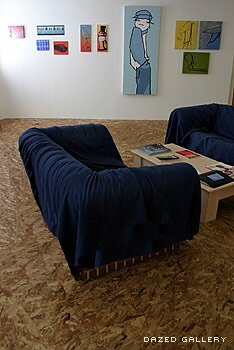
Directions: In Hanley, Stoke-on-Trent's city centre, find the Dazed shop on Brunswick St. (near the top of Piccadilly). Just walk up the stairs to the first-floor of the shop, and you'll find the large free white-wall Gallery at the back - with a settee & coffee table.
benny browne & co. is a modern friendly gallery, founded by designer Vanessa Browne & artist William Kemp, offering unique & limited-edition contemporary art to complement your home surroundings. All work is by artists exclusive to the gallery.
Directions: The gallery is in Longport, Stoke-on-Trent. Turn off the A500 at the exit signposted 'A527 Tunstall' at the roundabout, take the 4th exit towards Tunstall, follow the road for 600 yards over the canal bridge, and the gallery is within 'Top Bridge Works' on the left. Opening times: 10.30am - 4.00pm, 7 days a week. Artists on-site all days except Mondays & Wednesdays.
Buying original creative work in North Staffordshire:
1 :: Contemporary art galleries:
Blue? in Newcastle-under-Lyme.
benny browne & co, Longport, Stoke-on-Trent
Update: 2011, closed. Newfields Gallery, near Leek.
DAZED in Hanley, Stoke-on-Trent
King Street Gallery, Newcastle-under-Lyme.
Churnet Contemporary Arts, Cheddleton.
Reubens (40 High St., Newcastle-under-L), the town's main 'cool' cafe, shows the work of local artists on the walls.
The following major art galleries sometimes have 'selling shows':-
Burslem School of Art, Stoke-on-Trent
Potteries Museum & Art Gallery, (the annual Open)
Newcastle-under-Lyme Museum & Art Gallery
Keele University Art Gallery (painting & photography Opens)
2 :: Contemporary art ceramics:
The Ceramica shop in Burslem is a purpose-built showcase for a wide range of short-run ceramics being made locally, and is a good starting-place to get a quick feel for the some of the different styles.
The first Studio Ceramics Fair will be at the Gladstone Pottery Museum in Stoke-on-Trent, from 25th-26th Sept 2004.
3 :: Commissioning/buying art direct from artists:
Staffordshire Open Studios weekends are on 10th-12th, 17th-19th, & 24th-26th September 2004. Fine artists & crafts workers around Staffordshire will open their studios to the public. To order a paper copy of the brochure, contact Jenny Whiston on: .
And, of course, unique new work can be commissioned directly from many of the artists, designers and photographers listed on Creative Stoke!
Previous Creative Stoke front-page interviews:
Mark Wood...
The Frink School of Sculpture...
|